Today, we’re fortunate to have a guest contribution by Jeffry Frieden, Professor of International and Public Affairs and Political Science at Columbia University.
The second administration of President Donald Trump has remade American trade policy. In a new essay, David A. Lake and I survey the historical context for the Trump Administration’s trade strategy, examine the reasons for this dramatic turn in American trade policy, and summarize the likely domestic and international effects of the strategy. The paper is available here.
In this blogpost, I focus on the implications of the Trump trade policies for our analyses of the political economy of international trade. Just as the Trump policies are unprecedented in the post-war period from an economic standpoint – and, on many dimensions, unprecedented in American history more generally – they also represent a serious break with the way trade politics has worked over the past hundred years.
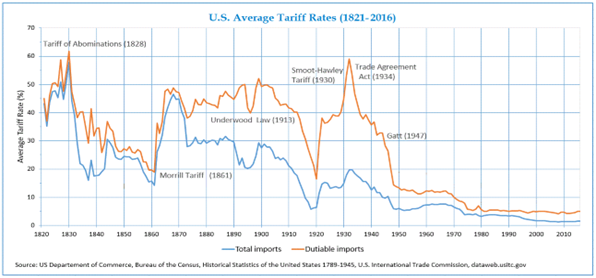
From the founding of the Republic until the 1930s, Congress made trade policy. Periodic trade bills would be cobbled together in the House and Senate, typically by logrolls that included most of the relevant and politically influential protectionist interests. Especially after the Civil War, tariffs were set at very high levels, especially by the Republican Party on behalf of its industrial constituencies in the Northeast and Midwest. Over the course of the early 1900s, new exporting and other internationalist interests grew concerned about the reciprocal impact of our tariffs on those of others; the Democratic Party largely reflected their more pro-trade stance.
In the 1930s, in the depths of the Great Depression, Congress passed the Reciprocal Trade Agreements Act, which delegated a great deal of trade bargaining power to the President. From then on, much trade policy has been managed by the executive branch and its independent agencies (such as the International Trade Commission). The original delegation was intended to impart a more pro-trade, less log-rolling, bias to trade policy, and it largely did so.
The Trump Administration has used a variety of means to take full control of trade policy, facilitated by a Republican Congress that seems content with this. Most of the means in question have to do with declaring the United States to be in one or another state of emergency – economic, national security, or otherwise unspecified. This strategy may not hold up in the courts, but it seems unlikely to matter, as the Administration will undoubtedly find other ways to impose the trade barriers it desires.
The Trump Administration’s trade policy appears to have several aspirations, some of which are not consistent with others. In rough order, Trump wants to rebuild American manufacturing, for both economic and security reasons. This goal may also reflect a political strategy to appeal to regions that have experienced a loss of manufacturing in the Industrial Belt. He also seeks to use tariffs to extract concessions on trade, drugs, and other non-economic issues. Finally, Trump wants tariffs to generate revenue for the government, perhaps to offset Republican tax cuts. The proximate aim is to balance the flow of goods between the United States and each of its trading partners, meaning that U.S. exports of physical goods should equal U.S. imports on a bilateral basis.
Although the dust has far from settled on the Trump trade policies, most analysts expect effective protection to end up in the 15-20 percent range. This is as high as we have seen in a developed country in many decades, and has a wide variety of economic implications.
Whatever the economic significance of these policies, the analytical implications are if anything more significant, for this is a massive departure from the way American (and other) trade policy has been made. The political economy of trade policy has been studied in great detail for many years, and there is a massive theoretical and empirical literature on it, both in the United States and elsewhere. But much of what has happened in American trade policy recently seems to diverge from the typical models we have of the making of trade policy.
Trade policy has generally been understood as a case of classical special-interest politics, in which the interests of producers are pitted against the interests of consumers. The canonical models of trade policy are these days largely subsumed within the Grossman-Helpman “Protection for Sale” framework. This takes into account the degree of organization of the interests, how much political power they have, and the deadweight costs of the policy; the result is a government that weighs the interests of protectionist industries against the interests of industries and individuals that consume imports (and tradables more generally) and aggregate social welfare. Trade policies are not normally particularly partisan, as members of Congress and other politicians of all stripes are primarily concerned about safeguarding the interests of their constituents.
In “normal times,” then, trade policy is special-interest politics, and not very ideological. This has been true in the United States since the 1930s. And yet there have been times when trade policy has been highly partisan, and very ideological. As noted, there were substantial differences between Republicans and Democrats in the late nineteenth and early twentieth centuries, and in the interwar period the country was similarly divided between protectionist isolationists and free-trade internationalists.
There are, then, times when trade policy leaves its normal tracks and becomes an issue of national political debate – largely over the very broad outlines of the policy in question, such as between isolationists and internationalists. Indeed, several years ago I helped coordinate a multi-country study for the Inter-American Development Bank about trade policy in Latin America, and we were very interested to find that this pattern was common there as well. In almost all times, trade policy was carried out quietly by special interests and their supporters, at the firm or industry level, with little public attention. But there were periods – often when a major trade treaty was being considered, or in times of crisis – when trade became high politics, and political parties divided bitterly over the broad outlines of the trade strategy to be pursued.
Today’s United States is in one of these periods, in which the nation’s strategy toward trade – and the international economy more broadly – is up for discussion. This is so novel in the last 80 years that it has taken many analysts by surprise, for a “centrist consensus” in favor of economic integration had prevailed in the United States since the 1940s. But the 2016 election was a watershed, in which for the first time in 100 years candidates for the presidential nomination of both parties ran on platforms explicitly hostile to international trade. Indeed, the stump speeches on globalization of both Bernie Sanders and Donald Trump were virtually indistinguishable. The first Trump Administration began the turn away from the centrist consensus; the Biden Administration did not really reverse this course; and the second Trump Administration has completed a more or less about-face in American trade strategy.
This does not mean that special interests do not matter. Some traditionally protectionist industries – steel, aluminum, autos – have received protection, and there have been thousands of requests for exemptions from tariffs. In fact, evidence from exemptions granted by the first Trump Administration suggests the relevance of standard political-economy motivations.
Nonetheless, it seems clear that what is in play is a broad strategic view of America’s role in international trade. Post-war American foreign economic policy – like the post-war international economic order more generally – rested on two pillars: American leadership and multilateralism. The current administration has called both these into question. It regards the United States as overstretched and overburdened, and sees multilateralism as inimical to American interests. While there are many, widely held, alternative views, they seem to have gone into hibernation in the face of the Trump Administration’s attempts to reverse the course of American policy.
The contending visions of America’s place in the world are not divorced from economic interests. Just as the isolationist-internationalist divide roughly tracked the economic interests of major American regions and industries, there is a clear division between the generally internationalist coasts and big cities, on the one hand, and the nationalist populists in heartland industrial and agricultural regions. Nonetheless, there are clear ideological and attitudinal distinctions between these world views that are not reducible to economic self-interest.
Competing conceptions of the American national interest in the trade and economic arena clearly relate to questions about the country’s broader role in an increasingly contentious geopolitical environment. China’s rise and Russia’s turn toward revanchist imperialism are significant challenges to the United States and its traditional allies. There are many ways they could be confronted; the Trump Administration has largely chosen unilateral and transactional approaches. This is certainly consistent with its trade policies, which have been unilateral and transactional; but it is hardly the only possible strategy.
Until recently, the modern political economy of trade seemed straightforward: special interests contended for influence over policymakers for policy rents. The Trump Administration’s turn has brought us back toward policy debates more reminiscent of the nineteenth and early twentieth centuries, when parties, regions, and ideologues contested the nation’s appropriate role in the world economy. Those debates implicated alternative views of national security, national purpose, and the national interest. The current debates raise analogous questions about what kind of country the United States is and wants to be, and how it wants to interact with the rest of the world.
This post written by Jeffry Frieden.
Source link