
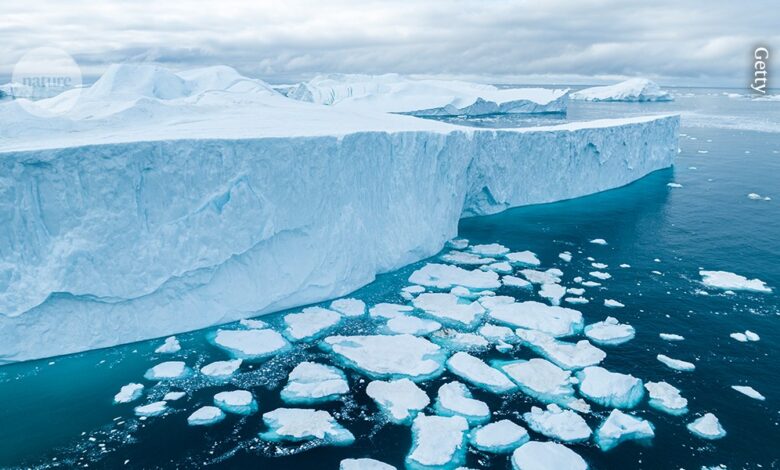
Unfrozen: The Fight for the Future of the Arctic Mia Bennett & Klaus Dodds Yale Univ. Press (2025)
From the rising temperatures of the climate crisis to the cooling of relations between Arctic states, metaphors of hot and cold pop up frequently in discussions about the Arctic.
Political geographers Mia Bennett and Klaus Dodds put them to good effect in Unfrozen. The book covers a wide range of subjects, from Indigenous sovereignty to economic development, military infrastructure and scientific research. It is a comprehensive, informative and entertaining account of centuries of climate and geopolitical change in the Arctic, and a look at what the future might hold.
The world just lived through the 11 hottest years on record — what now?
Bennett and Dodds are known for their communication skills, as well as their geopolitical expertise — Bennett’s blog Cryopolitics has long been a reliable resource on polar news and research. They make the complex accessible and the mundane memorable with compelling quotes and anecdotes in a book that will appeal to both the public and Arctic policy wonks alike.
Unfrozen centres on the many ways that this region is “unfreezing” — from melting ice to the heating up of previously cold conflicts, as well as the “unfreezing of norms and expectations around who gets to have a say in the Arctic”. Despite the title, the book spends little time speculating on the long-term future of a completely ice-free Arctic. Rather, Bennett and Dodds expertly guide readers through past, continuing and imminent changes in the region.
Growing threats
The authors highlight three scenarios for the Arctic’s near-term future: an extractive, an endangered and an adversarial Arctic. These visions are not mutually exclusive but they are intertwined, reinforcing why “the Arctic is a useful place to witness how societies and states are negotiating an environmental and geopolitical order”.

Greenland is important for global research: what’s next for the island’s science?
An extractive Arctic is marked by oil and gas development that is spearheaded by Russia and the United States. Bennett and Dodds draw attention to the possibility that extractive activities could economically benefit Indigenous communities in Alaska, Canada and Greenland, potentially improving their political position in the pursuit of sovereignty.
An endangered Arctic emerges from the ‘Arctic paradox’, whereby environmental alterations driven by climate change enable more oil and gas extraction. This exacerbates the climate crisis and creates a vicious circle of extractivism that spirals ever quicker towards an ice-free Arctic.
An adversarial Arctic would see increasing geopolitical conflict and competition for influence in the polar region, involving not just Arctic states such as Russia but also countries including China and India. Although Bennett and Dodds refrain from predicting “an all-out conflict in the northern latitudes”, the authors identify a rich buffet of vulnerabilities and historical precedents.
All three scenarios are already becoming reality, for example, as US President Donald Trump continues to push his extractive ethos of “drill, baby, drill”.
Rapid changes
To learn more about what is driving these changes, the authors turn to the Arctic’s past. They take readers on a journey through the climatic history of the region, which is experiencing warming four times faster than the global average, and up to seven times faster in some parts of the Arctic Ocean, such as around the Russian islands of Novaya Zemlya. As a result, the Arctic Ocean might be ice-free in summer by the 2050s, with some researchers even suggesting that this might happen as soon as the 2030s.

Demonstrators protest against US President Donald Trump’s push to acquire Greenland. Credit: Alessandro Rampazzo/AFP/Getty
Bennett and Dodds ponder what an ice-free Arctic Ocean might mean for international shipping or a future fishing industry that seeks to capitalize on species that migrate northwards amid changing climatic conditions. Ship traffic will increase, for example in the Barents Sea, whereas in other areas the loss of sea ice will erase ice-based transport routes for many northern communities, which the Inuit Circumpolar Council’s 2008 report The Sea Ice is Our Highway (see go.nature.com/3ddzarr) poignantly highlights.
Source link