Of the BLS, that is. From EJ Antoni writing in Heritage:
The mainstream media was predictably quick to denounce the labor market as weak according to November’s jobs report, but the talking heads are simply wrong. That alleged weakness is almost entirely confined to government bureaucrats and foreign workers, while private industry is employing more Americans.
Antoni, in a particularly telling moment, elides “foreign” with “foreign born”, as there is no CPS series on “foreign workers”.
When it comes to sprecific numbers, I am having difficulty replicating Dr. Antoni’s figures.
This was the best November ever for employment among native-born Americans, up more than 2.6 million over the last 12 months and setting a record, albeit on a non-seasonally adjusted basis. Conversely, the number of foreign-born workers with jobs declined over this period by 21,000.
This means that all the net job growth over the last year has gone to American workers, not their foreign-born counterparts. It’s a stark contrast to November 2024 when Joe Biden was president and native-born Americans saw an annual loss of almost 1.1 million jobs. During those 12 months, all net job growth went to foreign-born workers. [emphasis added – MDC]
As an aside, Antoni again slides in again “American” for “native-born Americans”, which in my mind is just a replay of Antoni’s previous “Great Replacement” Theory screed.
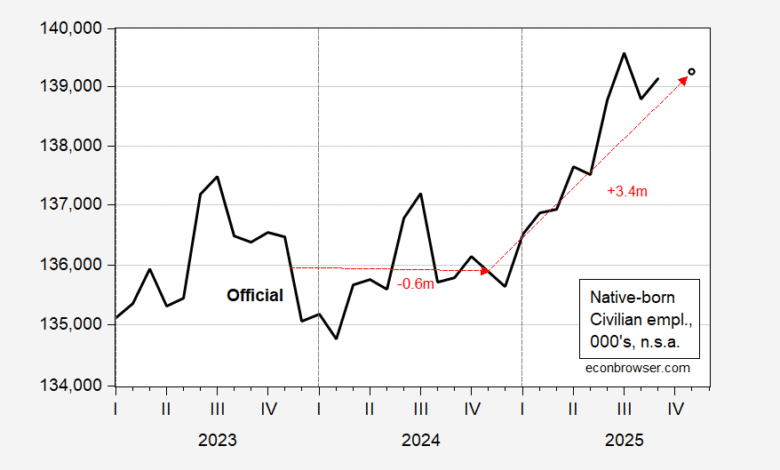
Using the official BLS numbers, I obtain the following series (bold black) in Figure 1:

Figure 1: Official native born employment (bold black), in 000’s, n.s.a. November to November change in employment, red arrows. Vertical dashed lines at new population controls. Source: BLS via FRED.
I find the 12 month change is +3.4 million, not +2.6 million (+2.6 million is total employment change, see Figure 2). However, if one plots the official employment series (FRED series CE16OV), one notes that there might be an issue taking the official series at face value (bold black series in Figure 2).
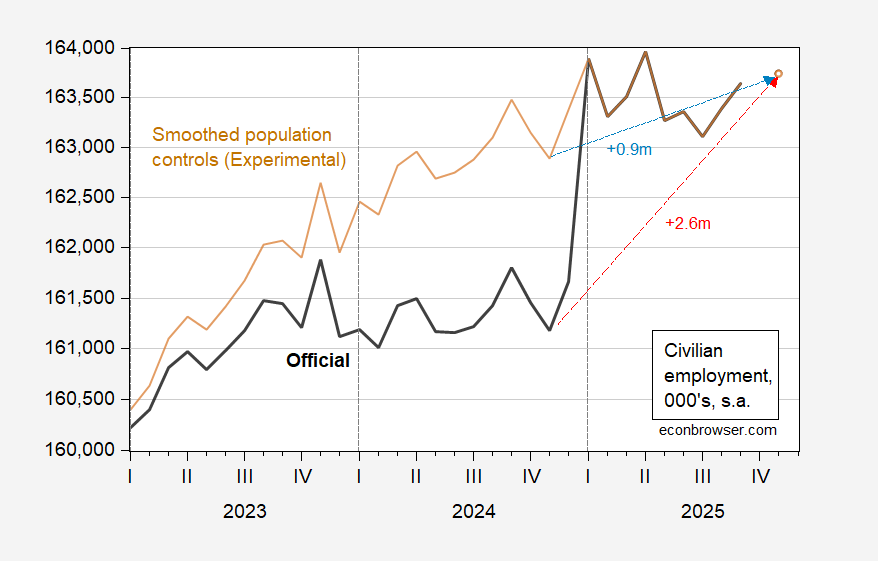
Figure 2: Official civilian employment (bold black), in 000’s, s.a. November to November change in employment, red arrows. Vertical dashed lines at new population controls. Source: BLS via FRED, BLS.
If one looks at Figure 2, without understanding the way in which the civilian employment series is calculated, then one might think there was an “astonishing” jump in employment in Jnauary 2025. The fact is that each year, new population controls are implemented; when the controls differ substantially from the preceding (or succeeding) year, then jumps — that are purely statistical artefacts — can be exhibited. Understanding this debate (which was quite prominent in 2024) induced the BLS to implement on a experimental basis alternative, “smoothed”, population controls. These alternative calculations yield the tan line in Figure 2. As is shown, instead of the +2.6 million increase, one obtains +0.9 million, y/y through November. While Antoni doesn’t cite overall increase, he should understand similar concerns apply to the level of native-born and foreign-born employees. Unfortunately, BLS does not publish an experimental version of the native-born/foreign-born series (to my knowledge). Hence, I estimate the native born level by (1) applying the ratio of native-born to sum of native-born plus foreign-born, and (2) adjusting the sum to reported total civilian employment. Here is the resulting addition to Figure 1.
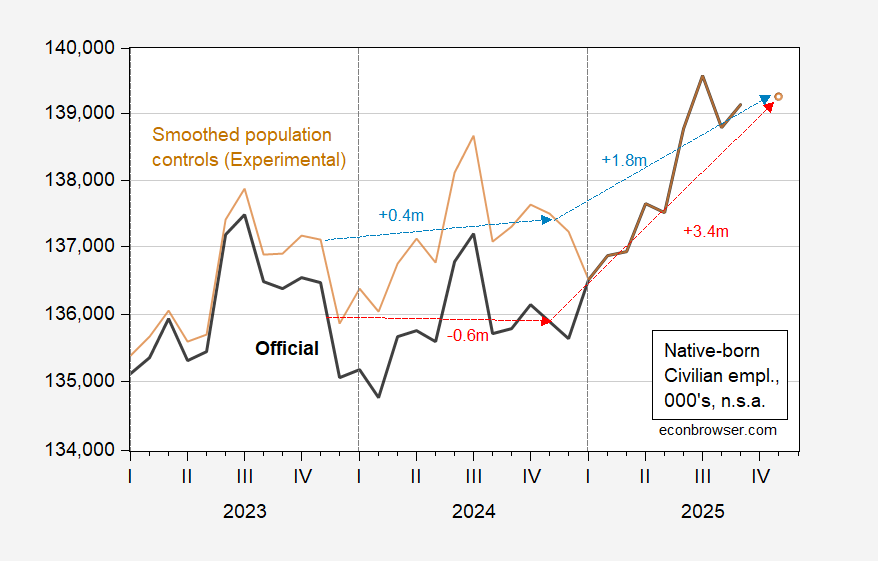
Figure 3: Official native born employment (bold black), and estimated experimental series (tan), both in 000’s, n.s.a. November to November change in employment in arrows. Vertical dashed lines at new population controls. Source: BLS via FRED, BLS, and author’s calculations.
The decrease in Biden’s Nov ’23-Nov ’24 native-born civilian employment (-0.6m) disappears, and becomes +0.4m, while the +3.4 million Nov ’24-Nov ’25 drops to +1.8 million.
In the end, I am unable to replicate a single number in Dr. Antoni’s section on the job market.
Finally, I am unsure whether I agree with Dr. Antoni’s conclusion that private industry is employing more workers. It really depends on what series you look at. If you have questions about the BLS birth-death model (as Dr. Antoni has in the past), one might look askance at the BLS series in recent months, and focus more on the ADP data.
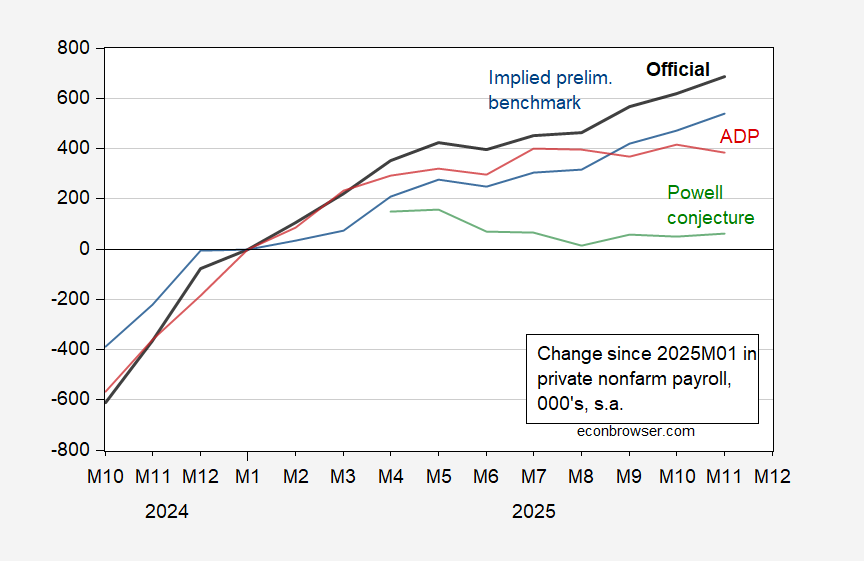
Figure 4: Change since 2025M01 of Official BLS nonfarm payroll employment (bold black), implied preliminary benchmark (blue), implied preliminary benchmark incorporating Powell conjecture (red), and ADP (red), all in thousands, s.a. Source: BLS, ADP via FRED, and author’s calculations.
Well, as they say, “A foolish consistency is the hobgoblin of little minds”.
* With apologies to Rudyard Kipling.
Source link