
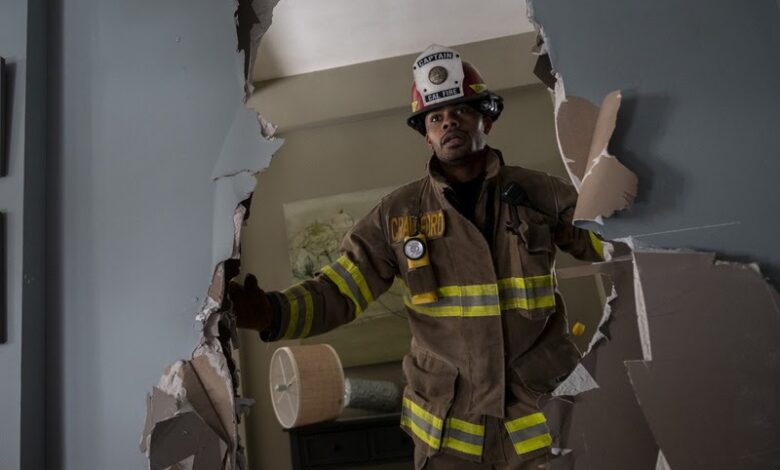
As Fire Country continues to put its characters through emotional and physical fire, Jake Crawford has quietly emerged as one of the show’s most layered figures. From being passed over for Battalion Chief to navigating family tensions and newfound brotherhood, this season has pushed him in new directions.
In an interview for SpoilerTV, Jordan Calloway broke down Jake’s mindset following his Battalion Chief disappointment, his complicated place within the Leone family, and why this chapter isn’t about falling apart, it’s about stepping into his power.
Calloway explained the reason behind why Jake becoming Battalion Chief mattered so much, Jake being passed over for Battalion Chief wasn’t just a missed promotion, it was deeply tied to identity, legacy, and loss. Calloway traced that back to Jake’s bond with Vince, “it was kind of not just a career path that he was always set out to do, but I feel like Vince being like a surrogate father to him carried much more weight.”
That relationship blurred the line between professional and personal in a way that defined Jake’s ambitions. Calloway explained, “He (Vince) filled the role of Jake’s father and Jake looked at him as filling the role of Bode for Vince for a period of time.”
In other words, stepping into Battalion Chief wasn’t just about leadership, it was about continuing something deeply personal. Losing that opportunity hit hard, but instead of breaking him, Calloway saw it as a necessary recalibration, “what they also had to learn and realize is that the two respectable individuals in their lives, they can’t be replaced, they serve a purpose, but they can’t be replaced. I think for taking the Battalion Chief, for losing that role, it did hit him, but it was a huge wake up call to him that it reminded him why he does this, that it’s not for anyone else, it is to save lives.”
 |
| “Sometimes the Chaos Wins.” Pictured: Max Thieriot as Bode Leone and Jordan Calloway as Jake Crawford. Photo: Sergei Bachlakov/CBS ©2026 CBS Broadcasting, Inc. All Rights Reserved. |
Not Breaking but Growing
It’s a subtle but important shift. Jake isn’t running anymore, he’s choosing to stand his ground. That growth is tied to his decision not to leave, not to escape when things don’t go his way.
As Calloway explains, “I think he’s (Jake) finding his legs to stand on, I think he’s finding his strength, his power and I think with what he had thought about with Butte, that was him running away and it took Violet to ground him and to remind him that for her, she’s not leaving. And it kind of was that thing of like, yeah, okay, you know what, I’m not going to stand for all of this stuff, but I’m not going to run away from it, and so he’s learned to fight and he’s learned to fight fairly, I would say.”
For a character who has often internalized frustration, that evolution is huge.
Family vs. “family”: The Malcolm tension
That preparation allowed him to build toward these moments, including one of the season’s most powerful lines, when Jake tells Sharon:
“You said I’m family, so help my actual blood family.”
Calloway doesn’t see that moment as explosive or resentful, but deliberate. “All he did in that regards was hold up receipts, he went back, got the receipts of the Leones, of 42, of Sharon, of Bode, and he’s just saying, we’re family. I’ve got family that needs help. There might have been a level of frustration, but I don’t think it was the level of frustration that got him to the point where he’s like, this is BS and I’m done and everything. No, it was a matter of ‘listen, these are the facts, right?”
Jake is no longer quietly accepting imbalance. He’s calling it out and importantly, he’s doing it without losing control. As Calloway explains, “I’m going to stand 10 toes down and I’m going to hold everybody here accountable for it because we can’t just pick and choose who we call family and who we’re going to go to battle for and you can’t expect that from me consistently, right?”
The Bode factor: Why Jake’s frustration runs deeper
Calloway acknowledges that underlying tension, “I think that plays into what he held Sharon accountable for, which was, look, we’ve done this for Bode time and time and time and time and time and time again. Not just Sharon, but also Manny. So I think, that frustration was like, ‘wait, why do I have to fight with you guys on this? I feel like this should be easy. I feel like this shouldn’t be a problem.”
At the same time, he understands the realities of leadership. Calloway explained, “it’s not just like, oh, no, it’s your brother and we can’t just because we don’t do that. It’s no, we’re full quota, full firehouse. I don’t know if there’s any room, like we’ve got to think about the finances, the money and the budgeting and all of this, and okay I understand that. That’s fair. So I need to ask somebody higher.”
Jake the bridge: Why he still matters at 42
That’s where Jake steps in. As Calloway shared, “I think you see that because in the episode, when Manny talks to Jake and he says, ’42 can’t survive without you,’ that rings for him and I think that also is sort of the wind behind his sails that allows him to say, okay, I’m in it, but I’m not going to take so much stuff from him. I’ve got to stand up.”
It’s a reminder that leadership doesn’t always come from rank, it comes from presence, experience, and trust, and Jake is finally starting to recognize his own value in that space.
 |
| “Like a Wounded Wildebeest.” Pictured: Jordan Calloway as Jake Crawford and Director. Photo: Eike Schroter/CBS ©2025 CBS Broadcasting, Inc. All Rights Reserved. |
Stepping into a new role: Director
Calloway gushed about his directorial debut, “oh, man, that was a blessing first and foremost and I’m just so grateful to JBTV, CBS and to my crew for giving me the opportunity.
There was so much creative freedom and it is just such a fun experience, the pre-production and production and post. I hope the audience enjoyed it.”
Directing gave him a new way to engage with the story. Calloway explained, “knowing these characters and then being able to find a way to tell their story through composition, it’s a different game, it’s a different trigger in your brain, and it gives you the ability to try and evoke emotions within the audience that you can’t do just in a performance. So I loved it.”
Calloway credits his parents for believing his directorial dream would become a reality, “funny enough, I never thought that I would be a director, but my parents, they knew it, they called it, so I just love it.”
And it’s something he absolutely wants to continue, “I would love to direct again. I do look forward to it, not just with Fire Country, but hopefully further in my career with other projects.”
What’s next: “A breath” for Jake and the audience
That reset isn’t just about lighter moment, it’s about returning to what makes the show work. Calloway explains, “yeah, we’re allowing ourselves to reset as a show and to kind of get back to the fundamentals of what Fire Country is supposed to be. Not getting lost in the incidences, but going back to the character development, going back to the character driven stories. I’m very excited and hopeful with Eric with much respect and love to Tia and our writing staff from before.”
Jake Crawford’s journey this season hasn’t been about losing, it’s been about redefining. He didn’t get the title. He didn’t get the easy path, but he’s gaining something arguably more important, his voice. And as Calloway puts it, that changes everything.
Source link