In a previous post, I noted that the January CBO projection of debt would likely be an underestimate, and perhaps increasingly so over time, suggesting upward pressure on rates.
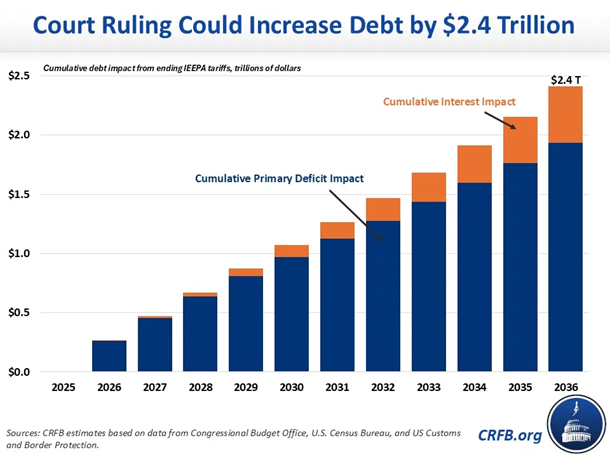
First, the IEEPA tariffs were ruled illegal. This means something on the order of $170 billion in refunds. While this has minimal impact on the debt level this year, it means any five year ahead debt projection should be revised upward relative to the February projection.
Source: CRFB (2026).
The IEEPA tariffs were partly replaced (economically speaking) by the Section 122 tariffs, which have been in part invalidated. If subsequently refunds are ordered, then first order there’ll be no net impact on debt.
The cumulative impact above includes additional interest costs, likely based on the CBO’s February projection. But the US-Iran war has pushed up interest rates.
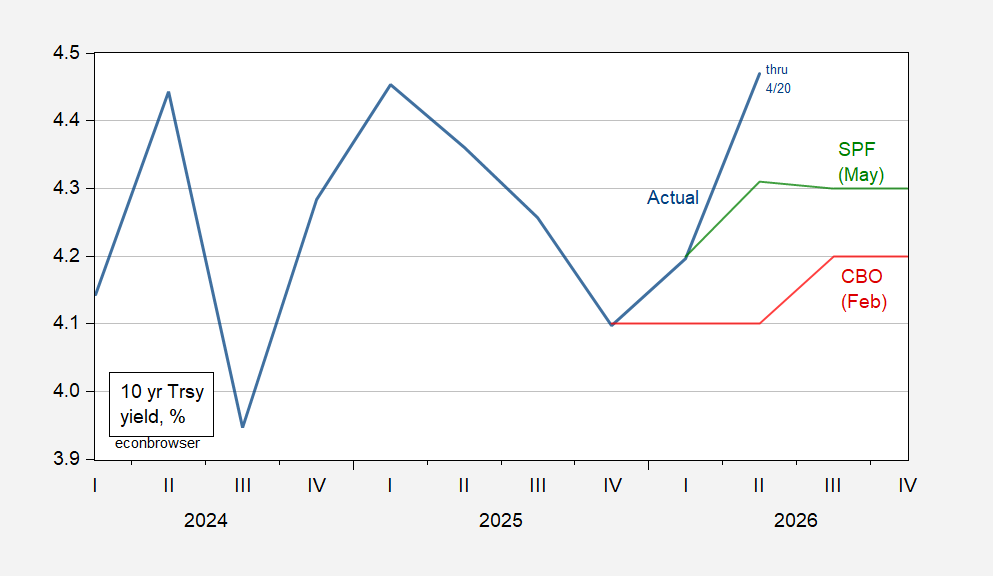
Figure 1: Actual ten year Treasury yields (blue), CBO (red), Survey of Professional Forecasters (green), all in %. Q2 actual is average for daily data through 4/20. Source: Treasury via FRED, February CBO Budget and Economic Outlook, Phildadelphia Fed (May).
What are the implications for the debt held by the public? I take the reimbursements at $175bn, the higher interest expenditures at $50 billion (the average Treasury 10 year yield assumed to be about 20 bps higher for the rest of the fiscal year than CBO assumed), and that expenditures in the US-Iran War at about $1 billion per day (in the lower mid-range of $500 mn-$2 bn). That means an additional $425 bn expenditures in FY2026 than CBO originally projected:
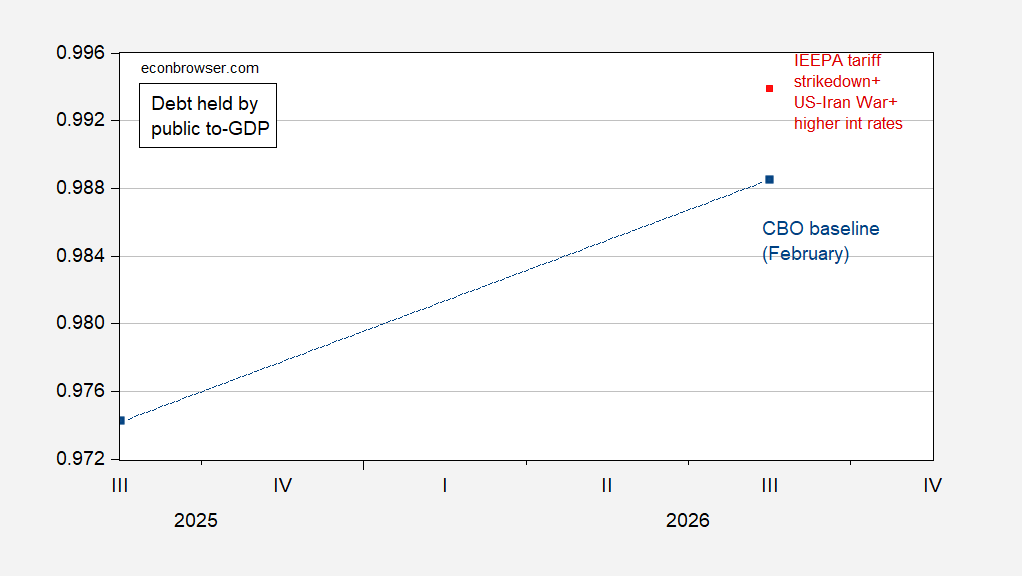
Figure 2: CBO baseline debt-to-GDP (held by public) (blue), and alternative incorporating IEEPA tariff decision and reimbursements, higher interest rates and war costs (red square). Source: February CBO Budget and Economic Outlook, and author’s calculations.
Other possible policy actions might further add to debt. A gas tax holiday lasting 4 months would cost another $11.5 bn.
In a rational expectations context, one could argue that current rates already incorporate the higher debt levels. After all the IEEPA decision was 3 months ago (although the reimbursements only started occurring much more recently). However, the war expenditures are only slowly being revealed (especially as duration is unknown), and the much higher interest rates are a more recent revelation.
Source link